Is YouTube Translate free to use?
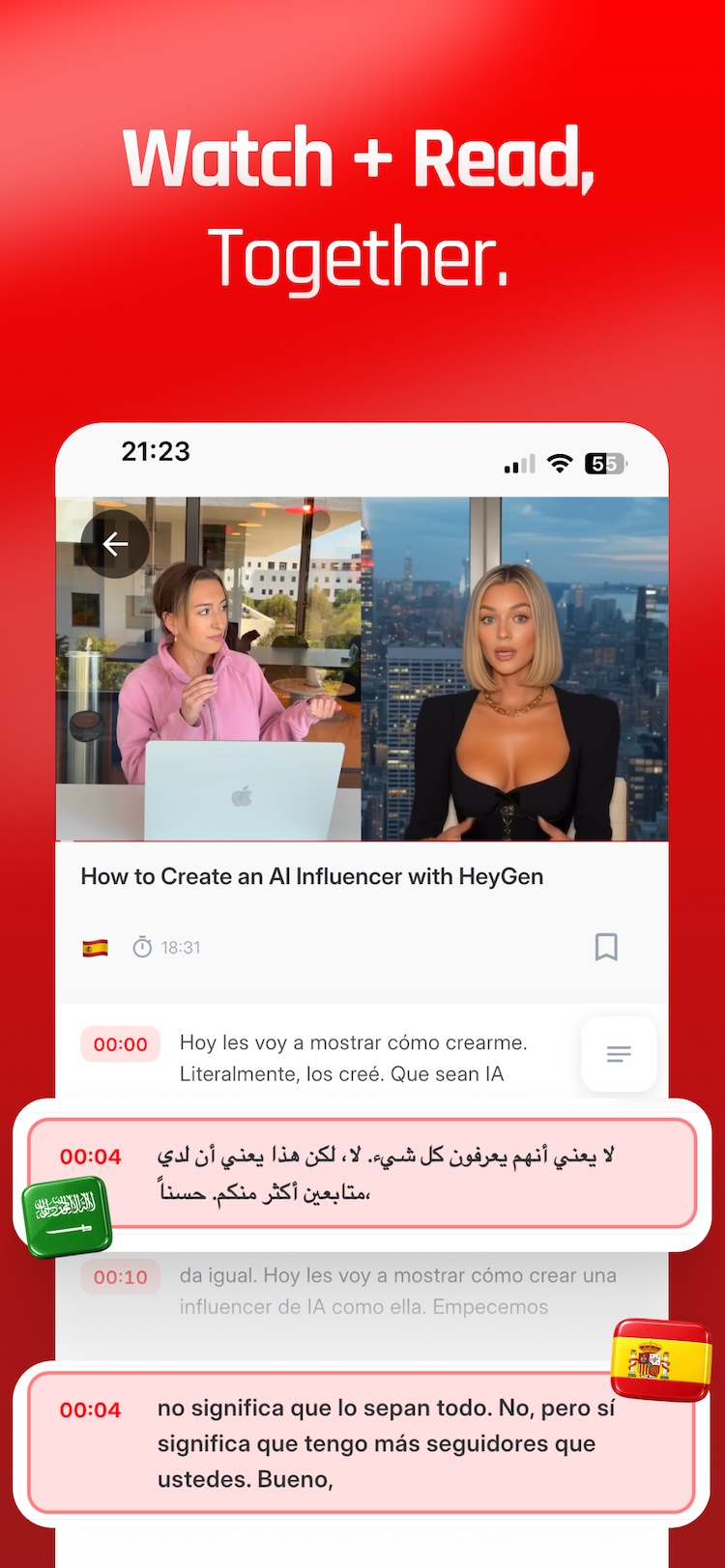
Yes, with a clear line between what is free and what is not. Extracting subtitles and transcripts from any public YouTube video that already has captions is free and unlimited — you can read them with timestamps, copy individual lines, and export the whole thing to PDF without an account, a card, or any daily allowance. What requires a Premium subscription is the work that runs an AI model: transcribing a video that has no captions of its own, translating a transcript into any of the 134+ supported languages, generating summaries, and building flashcards or quizzes. Premium purchases are handled by the App Store or Google Play and can be restored through the store account used to subscribe. Nothing you generate expires, and content already fetched stays readable on the device without a connection.
How many languages does YouTube Translate support?
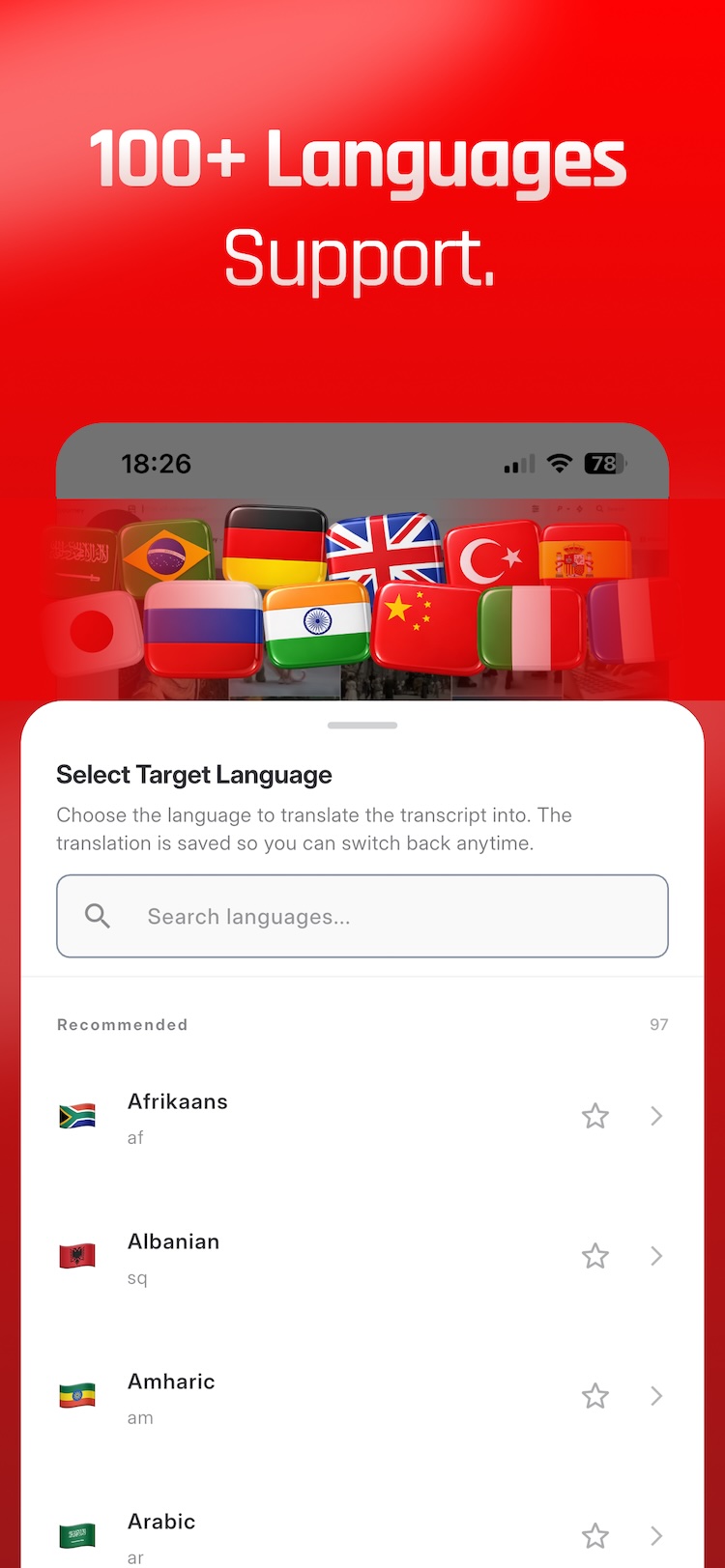
YouTube Translate translates into more than 134 languages, covering every widely spoken language plus many smaller ones — from English, Spanish, Arabic and Hindi to Turkish, Vietnamese, Ukrainian, Bengali and Filipino. You pick the target language per video, so the same transcript can be read in one language today and another tomorrow. Separately from translation, the app's own interface is localized into 30 languages, which means menus, buttons and settings appear in your language even if you are translating into a different one. Translation runs on the transcript rather than the audio, so the output keeps the original timing structure and reads as continuous text rather than machine-chopped fragments. There is no per-language surcharge: every supported language is included in the same Premium subscription. Source languages are detected automatically from the transcript, so you never have to declare what language the video is in.
Does it work with all YouTube videos?
It works with any public YouTube video that has captions, whether YouTube auto-generated them or the creator uploaded them — that path is free and has no length limit. When a video has no captions at all, the app can still produce a transcript by sending the audio to Google's Gemini model; that fallback is a Premium feature and accepts videos up to 2 hours. Directly requested AI transcription covers videos up to 1 hour. Three categories never work, regardless of subscription: private and unlisted videos, because YouTube's API does not expose them; live streams while they are still broadcasting; and videos we have removed on a copyright complaint. If a video falls into one of those, the app tells you which case it hit rather than failing silently. When a video is rejected the app names the reason rather than failing silently, so you know whether to wait, pick another video, or upgrade.
Can I save transcripts and translations as PDF?
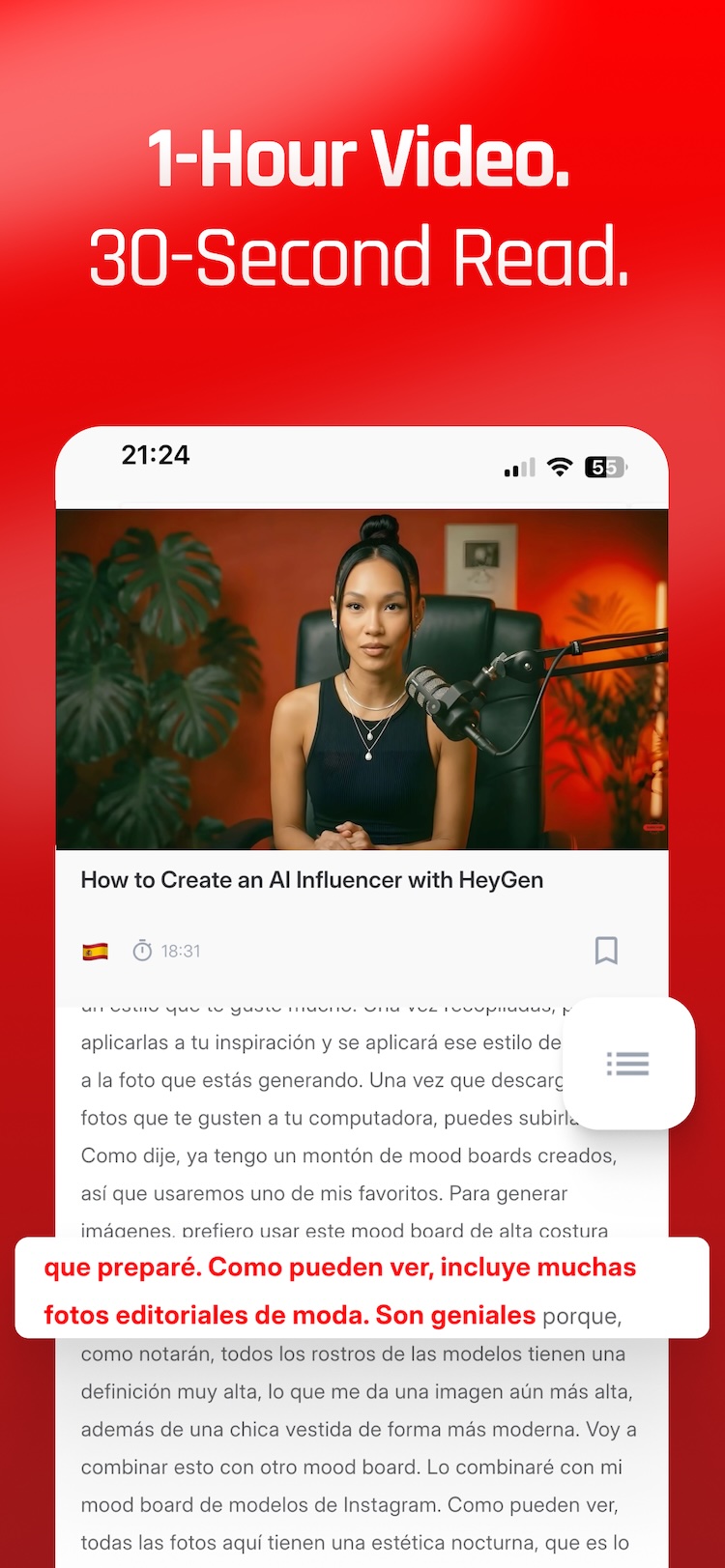
Yes. Transcripts, translations and AI summaries all export to PDF from inside the app, formatted for reading rather than as a raw dump — the video title and source link are included so the document is still traceable to its origin months later. The PDF goes through the standard iOS and Android share sheet, so you can save it to Files or Drive, mail it to yourself, drop it into a note-taking app, or send it to someone else. This is the usual route for students archiving lecture transcripts and for researchers who need the text inside a citation manager. Content you have already fetched stays available on the device, so an exported transcript can be reopened and re-shared without an internet connection. Summaries and translations export the same way, so a single video can leave the app as source text, a translation, and a condensed version.
What is the AI video summary feature?
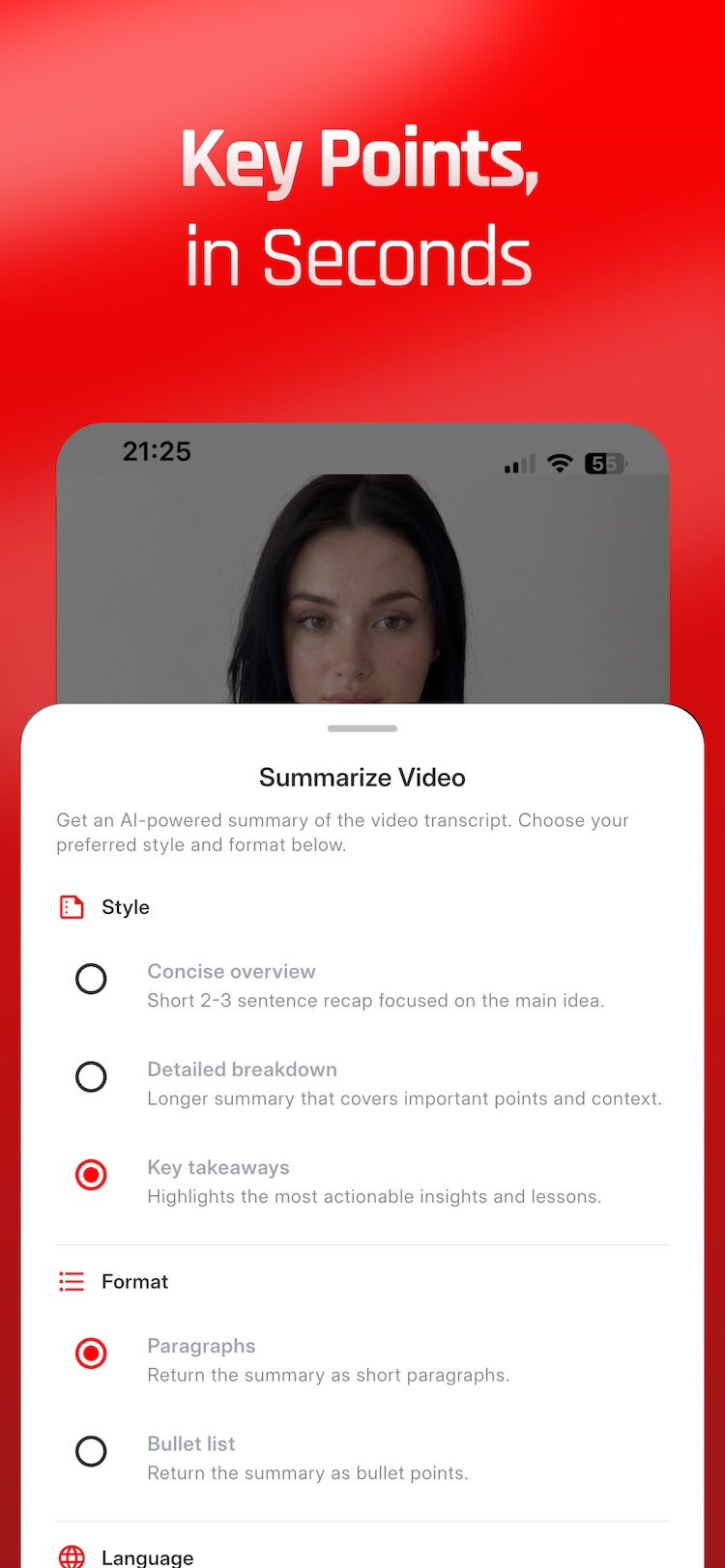
The summary feature sends the video's full transcript to Google's Gemini model and asks it for the substance rather than a paraphrase of the opening minutes. You choose the depth — concise for a quick orientation, detailed for a thorough recap, or key takeaways when you want only the actionable points — and the shape, either flowing paragraphs or a bullet list. The summary is written from the transcript, so it follows what was actually said instead of the title or description. By default it stays in the video's original language, and it can be translated afterwards into any of the 134+ supported languages. It is most useful on the material people do not want to sit through end to end: hour-long lectures, conference talks, podcasts and tutorials. Summaries are a Premium feature.
Is YouTube Translate available on both iOS and Android?
Yes — there is a native iOS app (iPhone and iPad) and a native Android app (phone and tablet), not a web wrapper. On the App Store the listing is called “Video Translate: Subtitles” and on Google Play it is “Youtube Translate & Summarize”; both are the same product, published by Yay Apps (Yaysoft LTD). Store naming differs from the website because app stores restrict third-party trademarks in app titles. Premium purchases are managed by the App Store or Google Play account used to subscribe. Most of the app, including free subtitle extraction, works without creating any account at all.